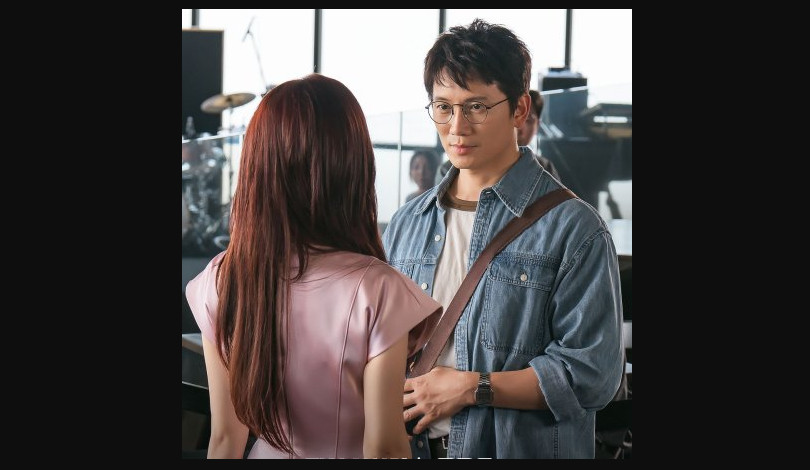
The Judge Returns Episode 3 opens with a shocking moment. Han-young deliberately runs over Sang-jin, a notorious serial killer. From a distance, Yun-hyeok witnesses everything, including the tense confrontation between Sang-jin and the judge who has mysteriously returned to the past.
When the ambulance arrives and takes Sang-jin away, Han-young plays innocent. He points to the skid marks near his car, framing the incident as nothing more than a tragic accident. As the police investigate further, a raid on Sang-jin’s apartment uncovers clear evidence linking him to multiple murders.
Han-young is later questioned by his superiors about his sudden “intuition” regarding Sang-jin. Chief Judge Baek Yi-seok appears quietly impressed, though he makes it clear that the case is still beyond Han-young’s official authority. At least for now.
Baek Yi-seok quickly establishes himself as a principled and unyielding figure. This is shown when he forcefully dismisses a lawmaker attempting to bribe him for a favorable ruling. Han-young later approaches Yi-seok, requesting to serve as a presiding assistant judge. His persistence earns Yi-seok’s respect, and he ultimately allows Jeong-sik to bring Han-young onto the team.
Meanwhile, Haenal Law Firm is struggling. Having lost all 12 of their previous cases, their reputation is in shambles. Yoo Seon-cheol becomes an easy target for Shin-jin and Kim Jin-han, who pressure him into joining their side. With no leverage of his own, Yoo Seon-cheol is forced to give in.
Attention soon returns to Sang-jin’s case. As a result of the hit-and-run, Sang-jin is left permanently wheelchair-bound. During sentencing, Han-young goes beyond delivering a routine verdict. Instead, he addresses the victims and their families directly, delivering a powerful and emotional speech that acknowledges their pain.
In the end, Sang-jin is sentenced to death. This decision not only closes a brutal chapter but also alters the timeline, saving a young girl and preventing a wrongful conviction that once occurred in the future.
The aftermath is far from calm. Jeong-sik is furious, knowing that every ruling remains permanently on record. Han-young, however, remains unfazed. Behind the scenes, S-Group has begun monitoring him closely. Han-young realizes this after spotting their presence at the Prosecutors’ Office and later follows them to a restaurant, where he comes face-to-face with Shin-jin.
Together with Kim Jin-han, Shin-jin continues to manipulate the justice system, aligning the courts with political power and private interests.
After participating in a genuinely fair trial, Han-young returns home noticeably lighter. He reconnects with his family, sharing a rare, heartfelt moment with his mother at the scrapyard where she works.
This timeline takes place before Han-young’s father suffers his life-altering accident. Despite being given a second chance to change the past, Han-young still struggles to face his father, weighed down by unresolved emotions.
The consequences of Sang-jin’s sentencing continue to ripple outward. As both punishment and test, Jeong-sik is ordered by his superiors to assign Han-young an especially difficult and controversial case. The intent is clear: to push Han-young to his limits and evaluate his true capabilities.
The new case centers on Park Hyeok-jun, who is accused of murdering his wife, Seon-hui, to collect insurance money. The policy was taken out three months before her death, naming Hyeok-jun, not her family, as the beneficiary.
Hyeok-jun owns a restaurant that reportedly earns around 300 million won annually. He claims to have no knowledge of the insurance policy, and investigators find no direct evidence tying him to its creation. However, the combined value of the policies totals a staggering 1.2 billion won.
Determined to uncover the truth, Han-young begins by visiting the accident site. Seon-hui’s car veered off a long rural road and plunged into the wooded area below. She died instantly on impact, while Hyeok-jun survived and managed to crawl away from the wreckage.
At the scene, Han-young encounters Song Na-yeon, a legal affairs reporter from Daejin Daily. In the future, Na-yeon will become a highly influential journalist. She also has a personal connection to the case, as Seon-hui was her close friend.
Han-young leverages this connection to draw media attention to the case and gather more information about Kim Ga-young, a key figure in Hyeok-jun’s circle.
Later that night, Madam Shin appears at the scrapyard. Her presence deeply affects Han-young, as her granddaughter was involved in the Gojin Chemical case from Episode 1. Han-young offers what help he can and apologizes emotionally, though Madam Shin has no idea why he is so shaken.
Elsewhere, Yun-hyeok is summoned to a secret meeting with Kim Jin-han and Shin-jin. A major reshuffle within the judiciary is underway: Kim Jun-man is set to become the new Chief Justice, while Baek Yi-seok is promoted to Justice. While framed as an honor, the move is actually designed to limit Yi-seok’s influence.
Returning to Hyeok-jun’s case, Han-young recalls that in his previous life, Hyeok-jun was found not guilty. Three years later, however, the truth emerged, Hyeok-jun had deliberately caused the crash to murder Seon-hui. Armed with this knowledge, Han-young is determined to ensure justice is served this time.
The episode briefly lightens in tone with a calculated encounter between Han-young and Se-hee, his future wife. Han-young intentionally makes her wait at a restaurant. When an argument with a waitress escalates and Se-hee slaps Han-young, the incident goes viral online. Se-hee is reprimanded by her father, while Han-young’s public image remains untarnished.
At court, Han-young delivers his judgment in Hyeok-jun’s case before an audience filled with lawyers and high-ranking officials, exactly as he intended. This time, his approach is far more meticulous.
He suddenly demands Kim Ga-young’s personal phone, suspecting it contains evidence of her collusion with Hyeok-jun. Though she initially lies, Han-young calls a specific number on the spot, exposing her deception in the middle of the courtroom.
The Judge Returns continues to draw comparisons to Taxi Driver in its portrayal of vigilante-style justice within a broken system. Han-young’s performance carries a quiet, commanding charisma, while the series exposes the darker undercurrents of Korean politics through layered power plays.
This episode marks a clear improvement over the previous one. Han-young begins to soften emotionally, particularly in his relationship with his parents. This added depth grounds his character and gives the series a stronger emotional weight.
The legal cases themselves remain compelling, though the story would benefit from placing Han-young in situations where his knowledge of the future does not guarantee an advantage. The time-travel mechanics remain somewhat vague—how does he remember every case so clearly, and how much do his interventions truly alter the timeline?
Even so, The Judge Returns stands out as an engaging legal drama with growing narrative complexity. With its expanding conflicts and moral dilemmas, the direction of the story remains intriguing, making the next episode highly anticipated.