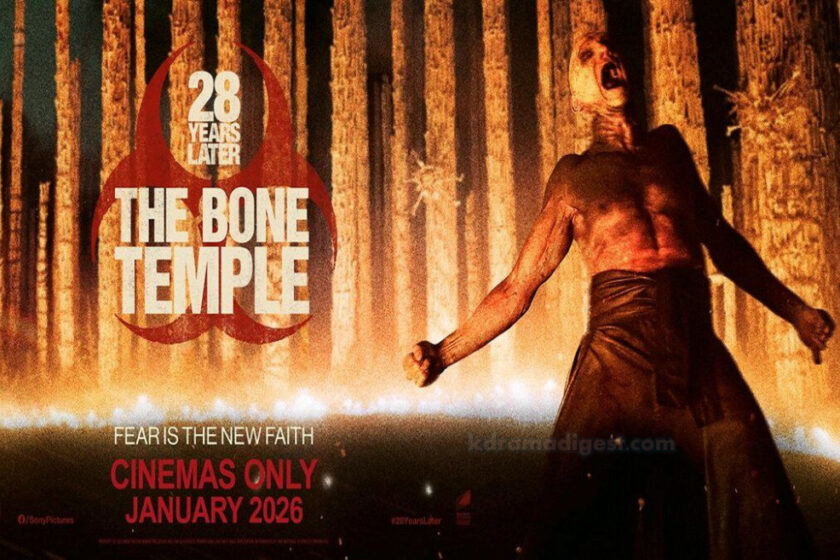
What is more frightening than zombies?
In 28 Years Later: The Bone Temple, the answer is delivered with unsettling clarity: human beings themselves. The film does not shout this idea; it lets it rot slowly under the skin, allowing discomfort to build scene by scene. This is not a story about infected bodies alone, but about infected beliefs, about what happens when desperation, faith, and power collide in a world that has already collapsed.
Written by Alex Garland, The Bone Temple continues the mythology introduced in 28 Years Later, while quietly reminding audiences that the 28 franchise has never truly been about the undead. Zombies are merely the backdrop. The real horror has always lived in human behavior when survival becomes the only remaining moral code.
The film picks up after Spike’s journey to save his mother, a storyline that closed the previous installment on a fragile emotional note. In The Bone Temple, Spike (Alfie Williams) finds himself crossing paths with a group known as the “Jimmies.”
At the center of this group is Sir Lord Jimmy Crystal (Jack O’Connell), a figure who blends charisma with cruelty so seamlessly that it becomes difficult to tell where belief ends and manipulation begins. For viewers who wondered why 28 Years Later opened with a brief glimpse of Jimmy as a child, this film provides the answer, slowly, and without mercy.
Jimmy Crystal believes himself to be a prophet. Not metaphorically, not symbolically, but quite literally. He gathers young boys, renames every one of them “Jimmy,” and molds them into followers who exist solely within his worldview. Individual identity is stripped away, replaced by devotion and obedience.
The film opens with a scene that immediately sets the tone. Spike is given a choice that is not really a choice at all: if he wants to join the group, he must kill his opponent. It is a moment designed to make the audience flinch, not because of graphic excess, but because of what it represents. Faith, here, is proven through violence. Acceptance is purchased with blood.
This opening does not just introduce a cult; it establishes the moral decay that has become normalized in this world. There are no speeches about right or wrong. The rules are simple, and they are horrifying.
On the opposite end of this broken moral spectrum stands Dr. Ian Kelson (Ralph Fiennes), a scientist attempting to preserve reason in a world that has largely abandoned it. Kelson has encountered the infected many times before, including Samson, an alpha zombie of immense size and terrifying strength, capable of killing with effortless brutality.
Yet The Bone Temple* marks a turning point for Kelson. For the first time, he decides to move beyond observation and survival. He experiments.
This decision is not framed as heroic or reckless; it is presented as necessary. In a landscape ruled by death and belief systems built on fear, Kelson represents the last remaining thread of rational inquiry. Through his work, the film finally offers new insight into the virus that created the infected, a development that feels earned rather than forced.
One of the film’s most striking narrative choices is the inclusion of a brief point-of-view sequence from the zombie itself. This is not a gimmick, nor is it played for shock value. It serves a specific purpose within Kelson’s research and expands the audience’s understanding of the infected without stripping them of their horror.
Following a well-regarded predecessor is never easy. Danny Boyle reshaped the zombie genre with 28 Days Later, then expanded its scope and mythology through 28 Years Later. The Bone Temple occupies an even more challenging position: it functions as a bridge between films, set firmly in the middle of a larger narrative still unfolding.
Director Nia DaCosta inherits this responsibility, and remarkably, she carries it without trying to imitate Boyle’s visual identity. Where earlier films embraced experimental cinematography and aggressive stylistic choices, The Bone Temple opts for restraint.
Visually, the film is simpler. There are no bold technical flourishes designed to demand attention. Instead, DaCosta focuses on control. She understands precisely when to shock the audience and when to deny them the comfort of seeing what is happening.
In one of the film’s most terrifying sequences, the camera refuses to reveal the violence directly. Sound design, performance, and framing do all the work. When the truth is finally revealed, the horror lands harder because the audience has already imagined something worse.
It is a reminder that fear does not always need to be shown. Sometimes, withholding information is far more effective.
Structurally, 28 Years Later: The Bone Temple tells a relatively straightforward story. It does not attempt to introduce an entirely new mythology or reinvent the rules of its universe. Instead, it expands upon what has already been established.
This simplicity works in the film’s favor. Garland uses the space to deepen existing themes rather than overcrowding the narrative with new ones. The result is a story that feels focused and purposeful.
The cult of the Jimmies explores how easily people surrender identity in exchange for belonging. Kelson’s research represents the fragile persistence of logic in a world that rewards irrational certainty. Neither storyline dominates the other; they exist in tension, mirroring the broader conflict between belief and reason.
The film’s emotional impact rests heavily on its performances, and here The Bone Temple excels.
Ralph Fiennes once again proves why he remains one of the most compelling actors working today. His portrayal of Dr. Kelson balances intellect, exhaustion, humor, and quiet sorrow, sometimes within the same scene. He never overplays the role, allowing restraint to do most of the work.
Alfie Williams brings vulnerability to Spike, ensuring the character never becomes merely a vessel for the plot. The audience cares about Spike not because the film insists on it, but because Williams makes his fear and confusion feel authentic.
Then there is Jack O’Connell as Sir Lord Jimmy Crystal. O’Connell delivers a performance that is deeply unsettling without relying on exaggeration. His Jimmy is charismatic, confident, and terrifyingly sincere. He does not believe he is evil, and that conviction makes him far more dangerous.
Following his roles here and in Sinners, O’Connell continues to establish himself as an actor uniquely skilled at portraying antagonists who are compelling, infuriating, and impossible to ignore.
At 109 minutes, 28 Years Later: The Bone Temple maintains a steady pace and avoids overstaying its welcome. The film is not without flaws. Its climax feels intentionally subdued, particularly given the extreme behavior previously associated with the Jimmies. Some viewers may expect a more explosive resolution.
However, the film’s true strength does not lie in its climax, but in its ending.
Rather than delivering a definitive conclusion, The Bone Temple plants a carefully measured hook for what comes next. The promise of continuation feels organic, not manipulative. It invites the audience back into this world without relying on spectacle alone.
28 Years Later: The Bone Temple may not be the most visually striking entry in the franchise, but it is one of the most unsettling. Its horror does not come from relentless action or excessive gore, but from ideas that linger uncomfortably after the screen fades to black.
This is a zombie film where monsters are predictable, but people are not.
And in the end, that is what makes it truly frightening.