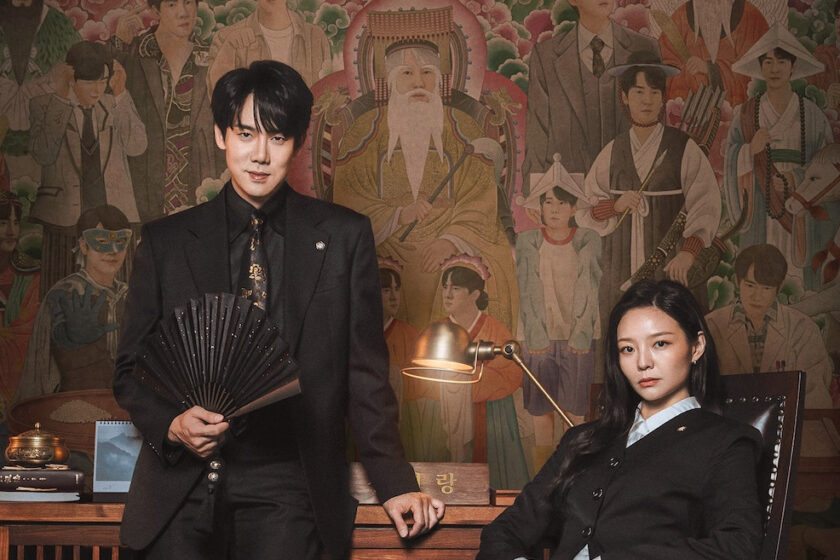
Episode 11 of Phantom Lawyer feels quieter on the surface, but underneath, it carries some of the heaviest emotional weight in the series so far. The story slows down just enough to let long-hidden truths rise, and once they do, everything starts to shift, legally, emotionally, and personally.
Things begin in uncertainty. Na-hyun and I-rang are left trying to make sense of Ms. Cha’s disappearance, while Dong-sik’s ghost, usually helpful, claims he remembers nothing. It creates a strange pause, like the story itself is holding its breath.
Then Ms. Cha returns, and with her comes the truth.
She admits the will was never real. It was dictated and written under false pretenses. But more importantly, she clears up the long-standing misunderstanding surrounding Seon-hwa. Her past unfolds in a way that feels painfully human, messy, emotional, and irreversible.
A younger Jeong-hui, heartbroken after seeing Dong-sik with Seon-hwa, made a reckless mistake. In a moment of drunken frustration, she revealed Seon-hwa’s identity to a stranger, not realizing he was a police officer. That one moment led to Seon-hwa’s arrest the next day.
What stands out here is not just the mistake, but how deeply it shaped everything that followed.
As the episode moves forward, the past becomes clearer. After Seon-hwa’s supposed death, Jeong-hui was left drowning in guilt, while Dong-sik stayed beside her. Their shared grief turned into something else, something softer, eventually leading to marriage.
But even then, Jeong-hui couldn’t escape the feeling that she had taken someone else’s place in Dong-sik’s heart.
That belief drives her promise to find Seon-hwa’s son and give him what she feels she owes.
Then comes the twist that quietly redefines everything: Seon-hwa might not be dead. A note left at her grave suggests she is alive, and suddenly, what felt like closure becomes a new beginning.
While I-rang immediately sees opportunity, Na-hyun reacts with frustration. From her perspective, too much damage has already been done. The lies, the misdirection, it’s cost them the case.
Her decision to pursue a settlement feels less like strategy and more like exhaustion.
Meanwhile, at Taebaek, Do-gyeong’s sense of control begins to slip. Ji-hoon confronts him, hurt by the truth that was kept from him. Instead of focusing on the case, he chooses something more personal, understanding his mother.
When Na-hyun meets Do-gyeong, the contrast between them is sharper than ever. She asks for a bold settlement, but what lingers is not the number, it’s how different she feels now. He notices it too, and in his own way, he resents it.
She no longer fits into the version of her he once knew.
When the negotiation fails, Na-hyun pivots. A new lawsuit, a new approach, and one key objective: find Seon-hwa.
The search brings them to an unexpected place, a dying public defender who still holds pieces of the truth. His notes point toward a prison incident, one that initially seems like a dead end.
But it isn’t.
A fire in the prison laundry room left two inmates severely burned: Seon-hwa and another woman named Sun-yeong. Official records say Seon-hwa died, but the details feel off.
The more they dig, the clearer the possibility becomes, an identity swap.
When Dong-sik’s ghost confirms their suspicion, the pieces finally fall into place. Seon-hwa has been alive all this time, hiding under a different name.
What makes this reveal more striking is how ordinary her life appears now. A noodle shop. A routine. A quiet existence far removed from the chaos she left behind.
Some of the strongest scenes in this episode are the quietest ones.
The conversation between Seon-hwa and Jeong-hui stands out because it reframes years of guilt. The truth is simple but significant: Seon-hwa’s arrest wasn’t caused by one mistake alone. It was already set in motion. That realization doesn’t erase the past, but it changes how it’s understood.
Ji-hoon’s decision is another subtle turning point. Faced with a manipulated paternity test, he chooses to trust something more meaningful, craftsmanship passed down through generations. It’s a quiet rejection of everything Do-gyeong represents.
And then there’s the moment at Dong-sik’s grave.
The shoes, the misunderstanding, the love that was never properly expressed, it all comes together in a way that feels both tragic and comforting. Dong-sik’s feelings were never where Jeong-hui thought they were.
He loved her all along.
That final truth gives his spirit the closure it needed, allowing him to finally let go.
Even with so many answers, the story leaves space for tension.
Do-gyeong’s actions hint at a willingness to cross even bigger lines. Losing control doesn’t seem to push him toward reflection, it pushes him toward more desperate choices.
There’s also the question of how far Seon-hwa is willing to go. Agreeing to talk is one thing, but stepping into a courtroom is another.
And of course, the episode ends on a note that feels both unexpected and very on-brand for the series. Just as I-rang is ready to be honest about his feelings, everything is interrupted by a sudden possession.
It’s strange, slightly comedic, and a reminder that this story never fully leaves its supernatural roots behind.
Episode 11 works because it doesn’t rush its emotional beats. It allows the characters to sit with their past, to question it, and in some cases, to finally understand it.
Na-hyun continues to grow into someone more independent, even if that path comes with uncertainty. I-rang, on the other hand, feels more grounded than ever, clear about what he wants and unafraid to admit it.
The contrast with Do-gyeong is becoming impossible to ignore.
At its core, Phantom Lawyer keeps returning to the same idea: justice is not just about winning a case, but about understanding the truth behind it. This episode leans fully into that idea, delivering something that feels both reflective and quietly powerful.
Rating: 8.7/10